
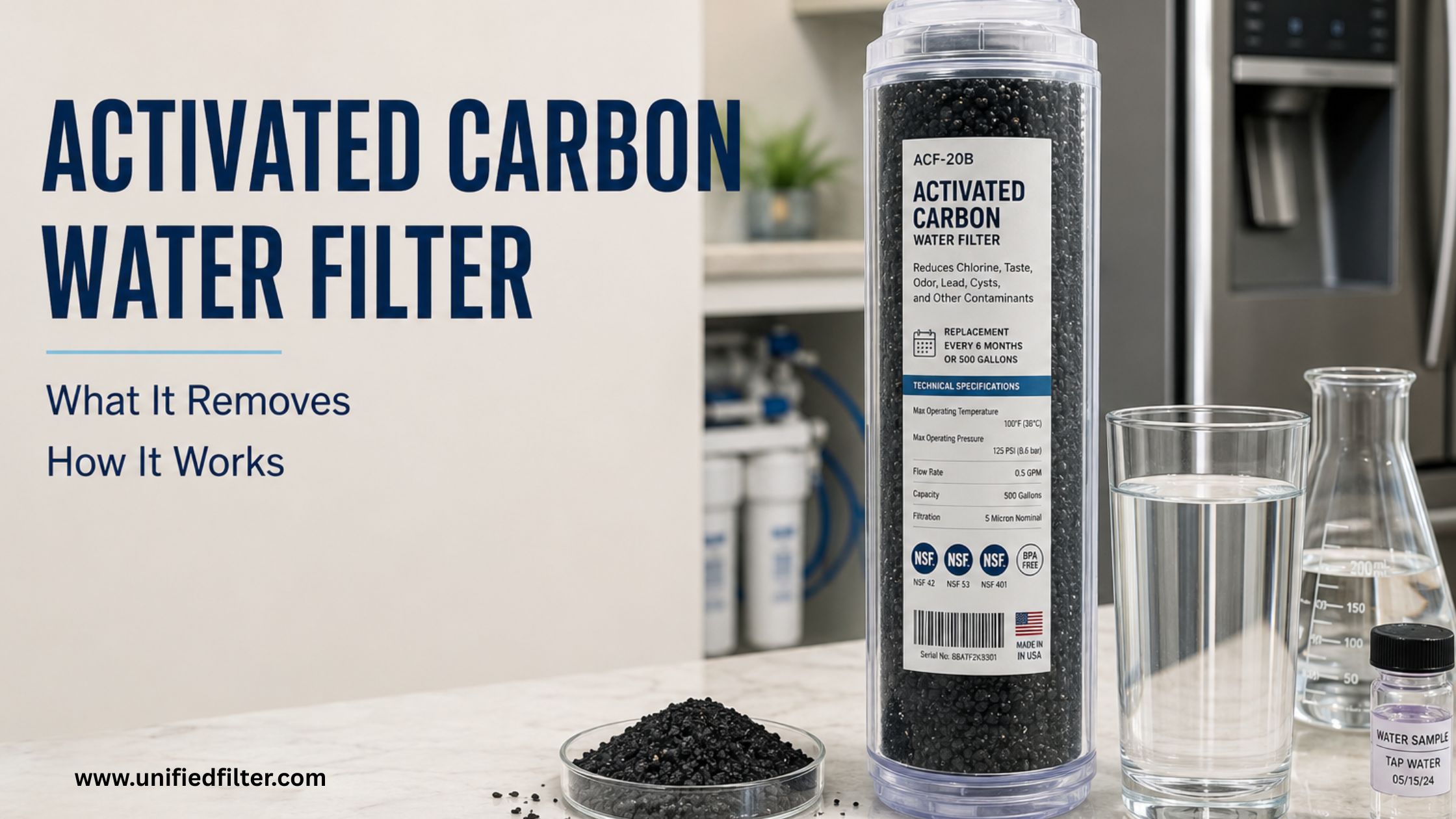
Activated Carbon Water Filter | How It Works, What It Removes, and Which Type You Need

An activated carbon water filter removes chlorine, VOCs, taste, and odor through adsorption contaminants bound to the carbon surface. Carbon block filters also remove lead and cysts. Catalytic carbon (not standard GAC) is needed for chloramine removal.
Activated carbon does NOT remove nitrates, bacteria, viruses, hardness minerals, or TDS. Your refrigerator water filter is an activated carbon block filter.One gram of activated carbon has a surface area of over 3,000 square meters, roughly half a football field.
This enormous surface area is why activated carbon is so effective at trapping contaminants, as water passes through, chlorine, VOCs, pesticides, and other organic compounds bond to the carbon surface through a process called adsorption.
Activated carbon is the most widely used water filtration technology in the world and almost certainly the one in your home right now. Your refrigerator water filter, your Brita pitcher, your under-sink filter, and your shower filter all use activated carbon as the primary filtration medium. Understanding how it works and what it cannot do helps you choose the right system and set realistic expectations.
How an Activated Carbon Water Filter Works | Adsorption Explained
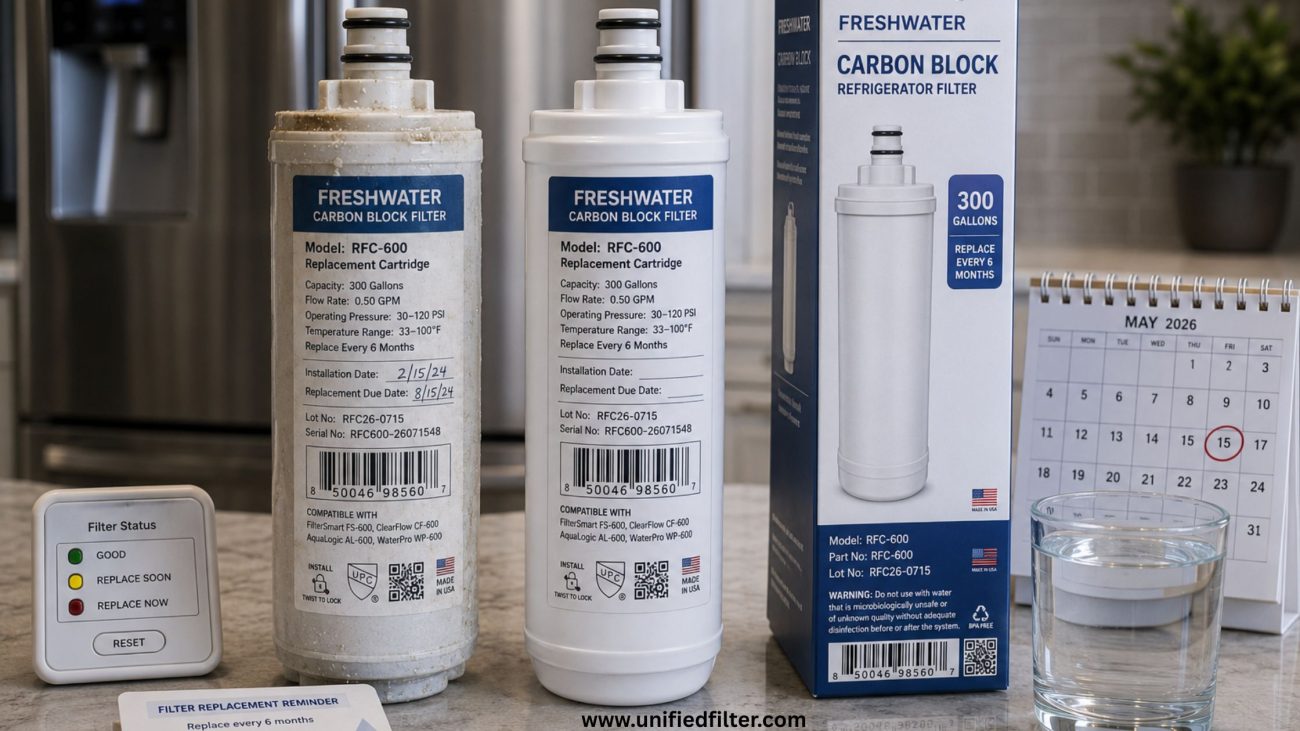
Activated carbon works through adsorption not absorption. The difference matters. Absorption means a material soaks up contaminants like a sponge. Adsorption means contaminants chemically bond to the surface of the carbon particles.
Carbon is “activated” by heating it to very high temperatures (800-1000°C) without oxygen, a process called pyrolysis. This creates millions of microscopic pores throughout the carbon, dramatically increasing the surface area. When water flows through the filter, contaminant molecules are attracted to and trapped in these pores.
The key implication is once the carbon surface is saturated all pores occupied the filter stops working. Unlike a mechanical filter that you can see get dirty, a saturated carbon filter looks identical to a new one. Water passes straight through with no visible change. This is why replacement on schedule matters, not just when you notice a taste change.
Coconut shell carbon is the gold standard material for residential water filters. It has more micropores than coal-based or wood-based carbon, meaning more surface area per gram and better adsorption of small organic molecules. Most premium fridge filters EveryDrop, Samsung OEM, Brita Elite use coconut shell carbon block.
Activated Carbon Water Filter Types | GAC vs Block vs Catalytic
Not all activated carbon water filters perform the same. The form of the carbon determines what it can and cannot remove.
| Carbon Type | Chlorine? | Chloramine? | Best For | Where Used |
| GAC — granular activated carbon | Yes | Poor | City water chlorine removal, basic | Pitcher filters, pre-filters, whole house tanks |
| Carbon block (CBF) | Yes, better contact time | Partial | City water, chlorine + lead + cysts | Fridge filters, under sink, pitcher (premium) |
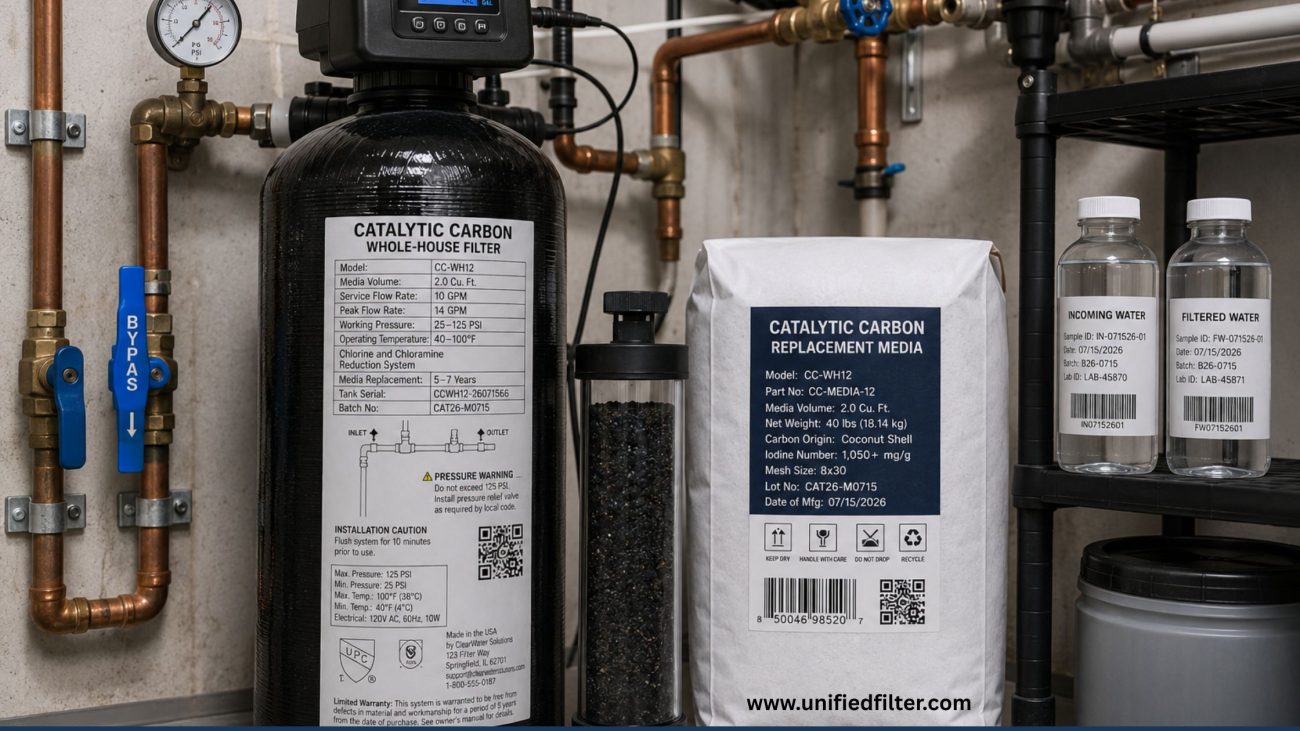
| Catalytic carbon | Yes, best | Yes, only carbon type that works | Chloramine cities, comprehensive whole house | Whole house tank systems (Centaur, SpringWell CF) |
| Coconut shell carbon (base material) | Yes | Depends on form above | Gold standard base, outperforms coal and wood | Premium fridge filters, Clearly Filtered, Brita Elite |
The chloramine distinction is critical, if your city uses chloramine instead of free chlorine, which 113 million Americans use standard GAC and even most carbon block filters provide limited benefit. Only catalytic carbon (like Centaur catalytic carbon in whole house systems) breaks down chloramine effectively.
What Does an Activated Carbon Water Filter Remove and What It Does Not
This is where most people have incorrect expectations. Here is the complete, honest breakdown for activated carbon water filters.
| Contaminant | Activated Carbon Removes? | Notes |
| Chlorine | Yes, all carbon types | Primary strength of activated carbon |
| Chloramine | Catalytic carbon only | Standard GAC largely ineffective |
| VOCs (volatile organic compounds) | Yes | Benzene, toluene, THMs, all adsorbed well |
| Lead | Carbon block only, NSF 53 certified | GAC does not remove lead block does mechanically |
| Cysts (Giardia, Cryptosporidium) | 0.5 micron block only | Mechanical filtration at 0.5 micron or below |
| Pharmaceuticals / PFAS | Partially, NSF 401/P473 certified only | Certified premium carbon block filters (EDR, Samsung OEM) |
| Nitrates | No | Requires RO or ion exchange |
| Bacteria and viruses | No | Requires UV sterilization |
| Total dissolved solids (TDS) | No, minerals stay in water | Carbon preserves healthy minerals a feature, not a bug |
| Hardness (calcium/magnesium) | No | Requires salt-based ion exchange softener |
| Taste and odor | Yes, primary benefit | Consistent across all activated carbon types |
Activated carbon does not remove nitrates, bacteria, viruses, or dissolved minerals including hardness. If these are concerns in your water well water bacteria, agricultural nitrate runoff, hard water minerals you need additional treatment, UV sterilization for bacteria, RO for nitrates, ion exchange for hardness.
Your Refrigerator Filter Is an Activated Carbon Block Filter
If you have a Samsung, Whirlpool, EveryDrop, LG, GE, or Bosch refrigerator with a water dispenser your fridge filter is an activated carbon block filter. Understanding this explains exactly what your fridge filter does and does not do.
What your fridge’s activated carbon block filter removes.
- Chlorine, all carbon block filters remove this
- Lead, carbon block at NSF 53 certified level (EveryDrop EDR and Samsung HAF-QIN are NSF 53 certified)
- Cysts (Giardia, Cryptosporidium), mechanical filtration through the tight pore structure
- Pharmaceuticals, NSF 401 certified filters (most OEM fridge filters carry this)
- VOCs, benzene, toluene, and organic compounds
- Taste and odor improvement, consistent across all carbon block filters
What your fridge filter does NOT remove.
- Nitrates, requires RO
- Bacteria, requires UV sterilization
- Hardness (calcium/magnesium), requires salt-based softener or RO
- PFAS, not certified in most fridge filters except GE XWFE (NSF P473)
This is also why replacing your fridge filter on schedule matters because saturated carbon provides no protection. A 6-month-old EveryDrop filter that looks pristine may be providing zero chlorine or lead protection.
Activated Carbon in Different Filter Applications
Activated carbon is used across every type of water filter but the specific carbon type and form varies by application. Here is how it is deployed.
| Application | Carbon Type Used | NSF Certification | Examples |
| Refrigerator filter | Coconut shell carbon block | NSF 42/53/401 | EveryDrop EDR1-5, Samsung HAF-QIN |
| Pitcher filter (premium) | Coconut shell carbon block | NSF 42/53/401 | Brita Elite, Clearly Filtered, ZeroWater |
| Under sink carbon | Carbon block (0.5-1 micron) | NSF 42/53 | Aquasana, iSpring, Waterdrop |
| Whole house tank | GAC or catalytic carbon | NSF 42 | SpringWell CF1, Aquasana Rhino |
| Shower filter | KDF-55 + GAC or calcium sulfite | NSF 177 (rare) | Weddell Duo, Jolie, Canopy |
| RV inline filter | GAC or KDF/GAC combo | NSF 42/53 | Camco TastePure, FRIZZLIFE |
Carbon block filters outperform GAC for health-related contaminant removal because the tighter structure creates longer contact time and mechanical filtration at finer particle sizes. GAC is better for high-flow applications where pressure drop is a concern.
Activated Carbon Water Filter Materials | Coconut Shell vs Coal vs Wood
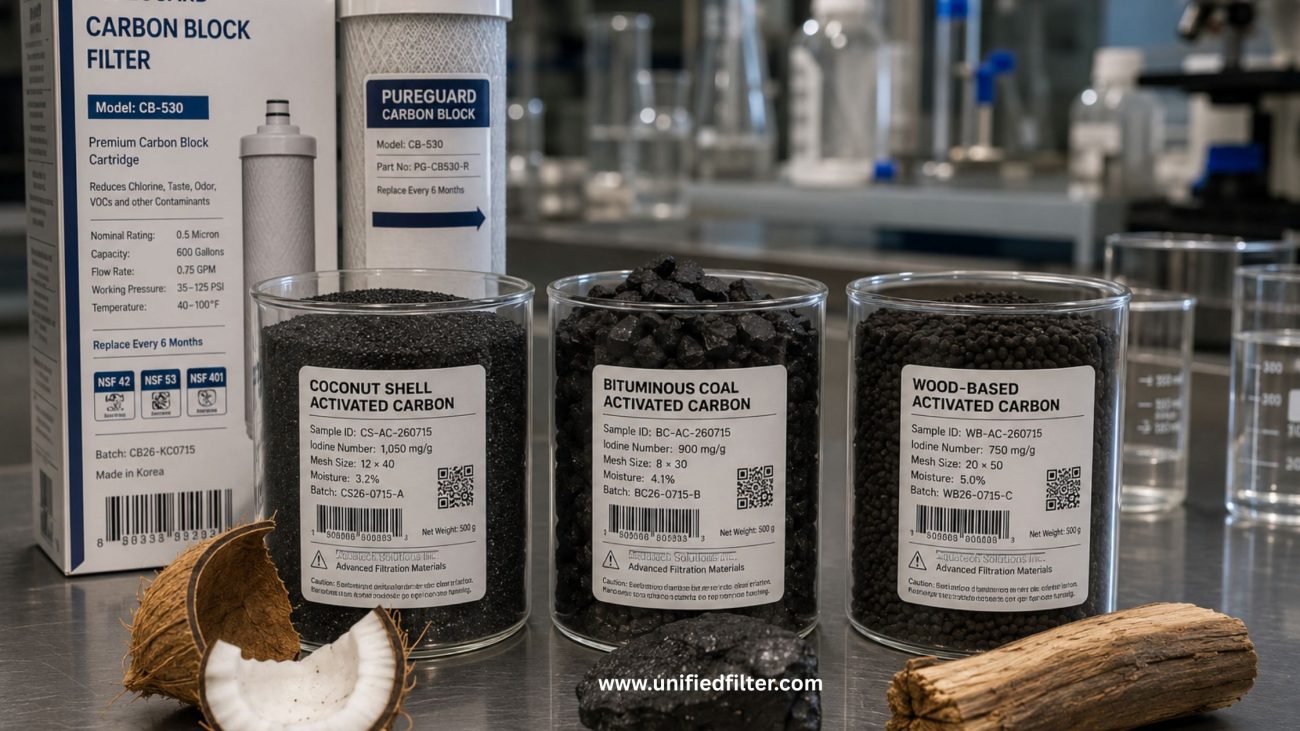
Coconut shell carbon: Gold standard for drinking water filtration. Highest micropore density, best adsorption of small organic molecules like chlorine and VOCs, most sustainable source. Used in premium fridge filters, Brita Elite, Clearly Filtered, and most certified under-sink systems.
Bituminous coal carbon: Larger pore structure, good for removing larger organic compounds. More common in industrial and whole-house applications where high flow rate is needed. Less effective for small molecule removal.
Wood-based carbon: Softer, less dense, shorter lifespan in hard water. Used in some budget products but not recommended for primary drinking water filtration.
When a filter specification says coconut shell activated carbon that is the indicator of a quality filter. When it simply says “activated carbon” without specifying the source, it may be using coal or wood based carbon.
Frequently Asked Questions
What does an activated carbon water filter remove?
Chlorine, VOCs, taste and odor, and (with carbon block) lead and cysts but not nitrates, bacteria, viruses, hardness, or TDS.
What is the difference between GAC and carbon block filters?
GAC uses loose granules for high-flow chlorine removal. Carbon block is denser, providing longer contact time and also removing lead and cysts that GAC cannot.
Does activated carbon remove chloramine?
Only catalytic carbon removes chloramine effectively, standard GAC and most carbon block filters perform poorly against chloramine.
Is a refrigerator water filter an activated carbon filter?
Yes,all major fridge filters including EveryDrop EDR and Samsung HAF-QIN use coconut shell activated carbon block, certified to NSF 42, 53, and 401.
How does activated carbon work?
Through adsorption, contaminants chemically bond to the enormous surface area of the carbon. One gram of activated carbon has over 3,000 square meters of surface area.